Google Custom Search
Showing posts with label Meditation. Show all posts

Thursday, April 23, 2009

What do Being Sick and Meditation have in common?

Dealing with my first cold in three years--ironically I came down with it at the tail end of a Florida vacation--I've noticed something odd about illness. Everything else seems to disappear. If someone has a fever, stuffy nose, or constant cough, there's little (if any) energy to think about anything or anyone else. The mind seems to crave relaxation and quiet. Personally I find a bath with my ears submerged while repeating inwardly, "I allow my mind to relax and be at peace," does wonders to relieve mental congestion.

Point is our typical thoughts disappear, at least mine do. Things that used to seem ever so important drop away as all inner resources are about healing. I realize this is only true for those that stay home from work to nourish themselves. I've been sick while caring for a baby and a toddler; let's just say that paints quite a different picture. But to stay in bed with some tea and allow your eyes to shut when they like and just to focus on the bodies needs is somehow meditative.

Now before you think I've gone off the deep end, let me explain. When we meditate, there is a hum or lightness to the body. The observer or witness takes over and thoughts are seen, but no longer control us. As meditation continues, a sense of calm inner peace soaks through us.

If we fight being ill, which I've done, the resistance builds and tension is felt everywhere. If we allow the illness to be there while focusing on nourishing the body and bringing it comfort, along with this acceptance is that same meditative detachment from the body, that same observation and peace.

Since I've been healthy for quite a while and love being in Florida, this particular illness baffles me. Being one that likes to learn from all of life's experiences, I look back on the vacation. I stretched my body every morning, skipped through Disney world (literally!), and enjoyed my mom's company. So, why get sick? Deepak Chopra advices we stop asking "why". Sound advice, yet I ask--slow learner I guess.

Thinking about it I realize that during the vacation, I didn't practice any hatha yoga or meditation. Days were packed and my mind and body were running on "excitement mode" for almost seven days straight. The adrenaline kept me moving and jumping; I felt like a kid again. This is all cool, but maybe, just maybe, my body and mind craved that down time. Peaceful time found during meditation and moving slowly with the breath. I was too busy having fun to even notice this lack of quiet--to busy loving the sun and warm temperatures--so my body decided it would force the time for stillness by getting sick.

I might not be correct in this reasoning, but just in case next time I'll just meditate!

Love Much,

Kris
www.TotalHealthYoga.com

Today is the first day of the rest of your life!

Friday, November 14, 2008

What is Prayer?


I used to think meditation was listening and prayer was talking to some higher force. As a child, prayer was a part of my evening ritual; I had even made up a bedtime prayer to use along with the Lord's Prayer. This "home made" one had more meaning to me as the church's version of the Lord's Prayer was not very relatable for a 7 year old.


As time passed, I came to realize that the prayers felt completely empty and void of any meaning. I could recite them backwards, forwards, and sideways while not actually paying any attention to the words. By high school, the ritual had become worthless; so I stopped.


Almost 20 years later, I became interested in meditation. After struggling all day to control everything around me, this practice of letting go was just what I needed. Prayer felt like one more attempt at controlling and meditation was being quiet and allowing things to be.


Now after a relatively consistent meditation practice for 5-10 years, I'm ready to check out this prayer-thing once again.


Just as there are many definitions or viewpoint of what meditation is, there are different mindsets regarding prayer. Gary Kraftsow lists prayer as one of the important elements of yoga. When I asked him how prayer was differed from meditation, he said, "It's a subset of meditation."


After doing a little research, I'm beginning to see what he meant.


In his book, Awakening the Buddha Within, Lama Surya Das describes prayer as "sacred speech." "In non-theistic Buddhism, as we pray, we are not petitioning for something so much as we are reaffirming our intentions and asserting our vows," (page 183).


One of the most useful ideas was uncovered in The Energy of Prayer by Thich Nhat Hanh. He points out that "in prayer there has to be mindfulness, concentration, insight, loving kindness, and compassion," (page 40). This points to the uselessness of "worry prayers." You know when you bargain with the divine while in a state of panic to have things go a certain way. Thich goes on to suggest the two most important elements in "effective prayer." "The first is to establish a relationship between ourselves and the one we are praying to. It is the equivalent of connecting the electrical wire when we want to communicate by telephone.... When we meditate on [the connection between ourself and the one we are praying for], communication is realized.... The second element we need for prayer is energy. We have connected the telephone wire, now we need to send an electric current through it. In prayer, the electric current is love, mindfulness, and right concentration," (page 41-43).


Finally, I would be remiss to talk about prayer without mentioning Dr. Larry Dossey. His books, Healing Words and Prayer is Good Medicine, can be used as a foundation to understanding and inspiring a regular practice of prayer.


I pray you are well and filled with love, compassion, and peace.


Kris
http://www.totalhealthyoga.com/

Today is the first day of the rest of your life!

Tuesday, October 14, 2008

Tao Te Ching - Mindfulness Exercises


When you look at this bird, what do you think? If you paused to explore the colors, poise, uniqueness and wonder of this creature than you have a knack for being mindful and connecting with everything around you. On the other hand, if you do what I've done countless times in my life, and said, "Oh, there's a robin." Then you have some work to do. Or shall I say "undo."

As a young child, you may have looked upon robins with wonder and curiosity. Perhaps you even tried to flap your arms like wings to see if you could fly. I remember watching intently after a spring rain, as robins hopped about the lawn munching on worms and other grub. I was fascinated.

Then our parents or teachers inform us that the name of this unique creature is "robin." With this label some of the wonderment disappears. Did you ever walk in the woods in different part of the world and notice how interesting the unknown foliage and critters are? When we name things, there's the underlying notion that we have it "all figured out" and some of the interest may diminish. Of course, the use of words are vital to our current form of communication, but the question is "how can we stay connected and still use words?"

When we label a group of people we separate ourselves from one another, unless they are part of "our group." When a doctor labels the patient with a condition or disease, frequently the symptoms worsen and panic sets in. Labels have the very strong ability to limit us in how we perceive things, people, and ourselves.

Did you ever notice how judgements about a person are really labels that we've put on someone? Are we limiting those relationships with this naming? When we determine a child is smart or not, are we setting boundaries for their own performance?

Do we need language? Yes. Do we need to attach ourselves to it? No. A matter-of-fact, I would propose being very careful not to. As Eckhart Tolle suggests, go into nature and see it, smell it, hear it, feel it, taste it, but do not name it. When you do this, a mystery unfolds and connection begins to return.

Consider the opening lines in the Tao Te Ching (The Way of Life--tao translates to the way or path):

"The tao that can be told is not the eternal Tao.
The name that can be named is not the eternal Name.
The unnamable is the eternally real."
Namaste,

Kris
http://www.totalhealthyoga.com/

Today is the first day of the rest of your life!

Tuesday, June 3, 2008

Mindfulness Meditation - Being Mindful of Your Thoughts

The other day Jake, my youngest son, was playing soccer in the rain. Wanting to see the game, but not wanting to stand in the rain, I parked my car in a prime spot to watch the game. The windshield started out clear and the view was great. Within a few minutes a smattering of rain drops sat on the window, but I could still see what was happening although the clarity was diminished. After five minutes or so, the view was almost completely obstructed and I'd have to flip on the wipers to clear away all the water and see clearly again.

Like the mind and thoughts. When we remove (or release attachment) to our thoughts, we can see clearly and know our source and live from a place of wisdom. Each thought that we hang onto becomes the raindrop on the windshield--gather enough of them and we cannot see (or even remember) our spirit that connects us all together.

Meditation, breath awareness, Hatha yoga, and walking in nature are a few methods to turn on the wipers and return to a place of knowing. Sometimes life is like being in a thunderstorm and that place of knowing is only a glimmer and disappears quickly. At other times it is easier to clear away the grasping thoughts and be in peace for longer periods.

If you find yourself attached to thoughts or just not "getting it", you might try Eckhart Tolle's suggestion of periodically throughout the day notice your thoughts and ask these two questions:

1. Am I the thoughts running through my mind?

2. Or am I the observer of these thoughts?

Finally, one last bit of wisdom from Tolle:

"Don't take thoughts too seriously."


Love Much,

Kris
www.TotalHealthYoga.com
www.TotalHealthYogaClasses.Blogspot.com

Today is the first day of the rest of your life!

Tuesday, April 1, 2008

What is Meditation

A couple of weeks ago, a small group of Yoginis were discussing meditation.

"I'm so bad at meditating."
"We all struggle with thoughts going through our heads."
"I try, but it just doesn't work."
"Can anyone really meditate?"
"It's hard."

Interestingly, so many people seem to be under the impression that if you think, you're not meditating. This is not necessarily true.

There are various forms and definitions of meditation. On one extreme the mind is to be completely void of any and all thought--good luck with that! The other extreme is to daydream and "go to your happy place." This is not truly meditating, but some would disagree with me.

Visualizations and meditations are different. Yet, many of us, me included, frequently use the word meditation to describe what is technically visualization. In the end, the word is not as important as what benefits you find from the method you use.

Posture is another element up for debate. When working with a disciple of Swami Rama, she recommending sitting in full lotus (padmasana) on an animal skin and a prayer shawl wrapped around the meditator. The skin and shawl were intended to keep the energy (Prana) inside the body. On the other hand, Erich Schiffmann once suggested meditating in a hammock under the shade of a tree in the summer time. Thich Nhat Hahn talks about mindfulness throughout the day, which in my opinion is like bringing meditation to every day life.

So what does meditation "do"? What are its benefits?

On a physical level, the heart rate slows, the breath becomes deeper without effort, and the whole body copes with stress in a healthier manner.

Mentally, you develop the ability to focus. With that said, if your mind is scattered all over the place like a messy house, then meditation will not immediately bring complete calm. Just as when you clean your home, it's a process to create order and structure within the chaos and disarray. If you continue to pick up, over time the house will become a bit cleaner and eventually, with discipline, it will be a more serene environment. The mind is like this too. The more you practice focusing your thoughts; over time they will begin to work for you and not against you. You will begin to choose what thoughts you'd like to maintain and what thoughts do not serve you.

Like magic, many people take up meditation to ease pain, be it physical or emotional, yet the spiritual benefits sneak in. With proper guidance and growing awareness, you begin to know you are not your thoughts or emotions. As you gain the ability to separate from thoughts, you experience oneness with others and sense a connection with the universe.

What's cool about this is that you are no longer controlled by negative things your parents or past lovers might have said about you. You are no longer sucked into the false belief that you are not good enough. Calm in what appears to be craziness is easier--not always, but it's a practice. Be patient.

Finally, what is "proper" meditation? Whatever works for you. Does repeating a mantra just become a drone in the back of your head while your thoughts take over? Does looking at a candle flame strain your eyes to the point of strong discomfort? If so, these techniques might not be best for you. On the other hand, if lying in a hammock brings you into complete awareness of the stillness in the ground below you and the sky above. If you feel the breeze on your skin and the aroma in the air sooths your soul, then you just might have stumbled upon a wonderful technique.

A teacher can help you to find a method that works, or you might find it on your own. My suggestion: Be very leery of anyone that tells you they have all the answers for how you should meditate. Only you will know when it's right. And be flexible with yourself. For years, I benefited from a longer early morning seated meditation. Now two brief periods a day with various focus objects each time work best for me.

Enjoy the practice. Don't beat yourself up. There is no "wrong" way; just sitting in silence for even a few minutes while watching your breath can have a positive impact on your life.


Love Much,

Kris
www.TotalHealthYoga.com
www.TotalHealthYogaClasses.Blogspot.com

Today is the first day of the rest of your life!

Monday, March 10, 2008

Anger Management Tips

When BJ (my firstborn) was an infant, there were days that I would call Scott (BJ's dad) and tell him to get home soon or I just might throw BJ through the window. (Don't worry, I never followed through!)

Looking back, and even at the time, I was filled with guilt and shame at not being able to calm this baby. He cried most of the time and suffered from chronic 3d degree colic. It was over four years before we actually slept through the night.

At the time, Yoga and meditation were foreign to me. I led a relatively unconscious life. I fully identified with my thoughts and emotions--not realizing they were not who I am.

Today, I believe that I would handle a challenging baby very differently. And I did handle my second child with more patience and centering.

What do you do when your emotions get the better of you? As one woman put on her blog, "What do you do when you can't take it any more?" The suggestions this blogger suggested in her poll are as follows:

I leave the situation.
I talk about it to whomever will listen.
I seek counseling.
I just suck it in and accept it.
I get it worked out on the spot.


I'd like to suggest some other ideas. In order to live a conscious life, which is truly what Yoga is about, consider other options to address feelings that storm in and want to take over:

Lie in savasana (on your back) and watch the feelings as a curiosity. See them for the energy that they are; not who you are but rather an energy passing through. Allow the feelings to pass and flow.

Meditate and find yourself re-connecting to Source. When you act from this place of peace, you separate yourSelf from emotions and act with more compassion and love.

Take a warm bath with the focus to renew. Use candles and soft music.

Take a walk in nature. If you stay present and notice the trees, birds, dirt, clouds, and sky, then you will begin to re-connect with who you really are.

In the throw of things, so to speak, stay aware. Resist getting pulled into your emotions. Watch them. Witness them. But always remember, you are not your feelings.


This all comes easier with a strong meditation practice. One might compare it to attempting to sail for the first time during a turbulent storm at sea. Odds are you'll sink. However, if you've been sailing in smooth waters and perhaps choppy ones, when the big storm comes you'll stand a good chance of surviving.


Love Much,

Kris
www.TotalHealthYoga.com
www.TotalHealthYogaClasses.Blogspot.com

Today is the first day of the rest of your life!

Monday, December 10, 2007

Open Heart


Over the weekend, Mike (my partner) and I went to see Lars and the Real Girl. It's listed as a comedy, and it is. Yet, I cried buckets at this bittersweet tale.

I won't give anything away regarding the movie, but going in you already know (or will find out within the first 5 minutes) that the story is about this fellow Lars who orders a human sized doll to be his girlfriend. He's not trying to be funny. She is very real to him. That's all I'll say about the movie's plot, other than that it's definitely worth seeing.

As most original movies do, this story triggered some interesting conversation on the drive home. Mike wondered aloud, "How many folks are like Lars? How many people are that socially withdrawn?"

"I imagine there's a lot more than we might think." I responded. "Not necessarily to the degree that Lars is. I mean everyone doesn't run around ordering dolls to be their friend and think they're real. But on some level I think most of us can relate to Lars in some way."

As we talked further, I was reminded of Yoga Teacher Training with Todd Norian a couple of years ago. There were almost 40 strangers in that space. We came together for three 9 day periods to learn, experience, and share. We ate together, studied together, practiced together, chanted together, and even shared rooms. With Todd's loving guidance and the 9 days of being on top of a mountain with nowhere else to go--and minimal cell phone accessibility--we grew very close. Masks came off and hearts were opened. On the final day, there was not a dry eye in the place. I felt connected and in love with each and every one of these souls. It was an amazing experience.

Just yesterday I was reading in IAYT Yoga Therapy in Practice an article Lynnet Tirabassi called Yoga of the Heart. The piece was about her training with Nischala Joy Devi for using Yoga to help Cardiac and Cancer patients. Aside from being a great synopsis and inspiring me to seek out more about Devi's work, Lynnet talked about the closeness that grew between the 35 participants. On their final day of the workshop, they chanted, "All I ask of you is forever to remember me as loving you." She says that by the end "all heart lights were radiating."

Why is this so unusual? Why don't we connect like this on a daily basis with everyone we meet?

Is it human nature to protect ourselves--physically and emotionally? Is it that protective shield we carry that prevents us from knowing and sharing our heart, our spirit, and our soul?

Perhaps a soul mate is someone that helps you to put down that shield and allows you to experience that beauty that you already are.


Meditate on the heart for the next week and see if you feel, think, and act a little more compassionately and lovingly to yourself and those around you. Next week or next month (after really focusing on my heart center), I'll post or leave a comment regarding my experience, and would love to hear about your experiences as well!


Love Much,

Kris
http://www.totalhealthyoga.com/
http://www.totalhealthyogaclasses.blogspot.com/

Today is the first day of the rest of your life!
Monday, November 26, 2007

Sacred Space

Zena Moon (Carla Blazek) recently entered a post about creating a personal space. She addresses the space not just of the physical, but of the emotional and mental as well.

When I think of a personal space, I think of somewhere that is safe and "at home." A sacred place where I can completely be myself without judgement.

Just last night, I was reading The Circle, by Laura Day. Chapter 3 talks about having a ritual. She suggests creating a sacred space for that ritual, and I realized that the most sacred space is within.

With this is mind, here's the comment that I left on Zena Moon's post:

I love what you said about sacred spaces. Just yesterday I was reading about creating a special place. As I sat, I closed my eyes and paused from the reading. I let out a surrendering sigh, and felt my sacred space deep within me. As I softly opened my eyes, I came to realize that my sacred space is not just where I have an alter or a special room in my home. It is in my heart and stays with me always.

With that said, it wasn't always that way for me. There were years (over a decade) when I only felt safe in my (now former) husband's arms. Then for a while there seemed nowhere that was "home." Then only with my kids. Then only with kids or meditating. Then in nature. Then when teaching. The list went on and on.

After years of meditating and the experience of coming back to Source again and again with the help of Yoga, I finally can rest inside. Maybe not all of the time, but even a glimpse of true inner peace is enough to bring me back to meditation and Yoga over and over.

Love Much,

Kris
www.TotalHealthYoga.com
www.TotalHealthYogaClasses.Blogspot.com

Today is the first day of the rest of your life!

Monday, September 17, 2007

Meditation - Finding your meditation object

Q: I'm not a "good" meditator. My mind keeps jumping around. What can I do?


A: Other than perhaps some monks living in the Himalayan caves, none of us are "good" meditators. That is, if a "good" meditation means that the mind is completely blank and no thoughts occur, or that you're completely aware of your connection with the entire Universe in every cell of your being the whole time.

The brain thinks, and thank God for that! Like it or not, our egos separate. Without this we'd be unable to function in society. I have read many accounts of some great sages and monks regarding their own meditation practice. Everyone seems to have times where there is a distraction (physical or mental) that keeps tempting the mind. The key is to not judge it or label it. (Some schools of thought advocate labeling, but I have found that more distracting.)

Think of your meditation as a practice for life. Just as your mind may be loud and trying to pull you in different directions, life can feel chaotic and demanding at times. A centered person is able to resist constantly get caught up in life's activities. They are able to enjoy all that happens while maintaining an inner knowing that there is connection and an underlying source behind all that we experience. Your meditation is a practice of consciously connecting to, or feeling, this source. It's a remembering of who you really are.

One of the keys to meditation is choosing an object to focus on that works for you. A typical place to start is to focus on the breath. Some people do better with a Yantra, Mantra, a physical statue to gaze upon, visualization, or even an idea (such as love or oneness). If you have used various objects, but the thoughts are stronger and keep bringing you away from your focus, then it might be time for a different approach.

Imagine that you are seated in the middle of your brain. As thoughts come in and "jump" about, watch them. Don't try to fight them or stop them. Stay focused on observing them. Like a loving parent watching over their children. YOU are the parent--the observer. Thoughts are NOT you. They are energy, but they do not define who you are. Thoughts are like children. You stay seated, while they run about. If a thought grabs you and pulls you down a long train of thoughts, this is like the child grabbing the parent's hand and pulling them along. Lovingly and without judgement, You return to the center. This is the practice.

Just as the Hatha Yogi doesn't do good or bad--they go to where they're at that day and work from there. Same thing when meditating. The Mediator, or Raja Yogi, doesn't do good or bad--they go to where they're at that day and work from there.

To enjoying where you're at,


Kris
http://www.totalhealthyoga.com/
http://www.learnyogaonline.blogspot.com/

Today is the first day of the rest of your life!

Friday, September 7, 2007

Meditation Techniques - Using the Light

Q: I see white blurry light when meditating with open eyes. At times tears form. Sometimes purple blobs of light come up. This can happen during a Yoga pose or when sitting. Do you know anything about this?


A: Let me start by saying it is not uncommon for people to see an inner light with eyes closed. I am not as familiar with eyes open. With that said, here are some things to consider:


Be sure you are breathing fully. Some novices hold their breath to get a "head rush" and see colors! This is NOT helpful or spiritual in any way. If your breath is comfortable and you are not forcing, then the light can be a deeper more energetic and positive experience.

There are two frames of thought on how you can use the light to deepen your spiritual experience. One is to meditate on the light as if you are moving closer to the source of it.


Another is to notice three distinct phases. The first is labeling the color, such as calling it "white". This is the grossest and most physical stage or dharana. Next is to focus on the light and the process of simply observing it. This is dhyana Finally, you absorb the light and merge with it. Here you have reached samadhi.

If you meditate with open eyes, tears can form from lack of blinking and the need to re-moisten. Or, it can be an emotional release. You will know best, as dry eyes are uncomfortable and emotional release feels..... well, releasing.

Finally, it is important to consider possible physical aspects of the color. I asked an eye doctor about this and she said, "Retinal nerve fiber processing can become overloaded from staring at a single object or space, creating the appearance of colors or spots. Blinking and eye movement restore retinal functioning. If the cornea dehydrates from reduced blinking, dryness and then swelling can certainly alter the vision."


Love Much,

Kris
http://www.totalhealthyoga.com/
http://www.learnyogaonline.blogspot.com/

Today is the first day of the rest of your life!
Monday, August 27, 2007

Spirituality and Health

In the March/April 2007 issue of Spirituality & Health, Louise Palmer wrote an article titled How Stress Shrinks Your Brain. It seems that stress lowers the number of brain cells in rats. When under stress, the part of the brain used in making decisions and paying attention were especially compromised.

Don't fret! There's hope for your brain. Aerobics not only slims your tummy and helps your heart; it, also, grows your brain.

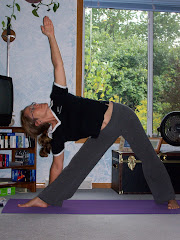
There's a lot of controversy regarding whether-or-not Yoga can be aerobic. Timothy McCall, M.D., author of Yoga as Medicine, admits that "not all Yoga is aerobic." Yet, "if you do it vigorously or take flow or Ashtanga classes, it can boost your heart rate into the aerobic range."

Regardless, of the style of Yoga that you practice, all Hatha Yoga improves the efficiency of the body's ability to use oxygen. Also, breath capacity is increased. Add in a dose of meditation, which reduces stress, and your getting smarter already!


Love Much,

Kris
http://www.totalhealthyoga.com/
http://www.learnyogaonline.blogspot.com/

Today is the first day of the rest of your life!
Friday, August 24, 2007

God - Connecting with God through Meditation

"We need to find God, and he cannot be found in noise and restlessness. God is the friend of silence. See how nature - trees, flowers, grass- grows in silence; see the stars, the moon and the sun, how they move in silence... We need silence to be able to touch souls."- Mother Teresa

A wise student once shared with the class "to listen to what I mean, not what I say." This stemmed from a conversation about the use of a term to describe the force behind our thoughts, the energy that is only felt yet not seen, the presence that brings with it peace and true happiness. Some call this God or Jesus. Others like Buddha, Allah, or Krishna. The list doesn't stop here. You might have heard Mother Earth, Higher Consciousness, Self (with a capitol "S"), Divine Nature, or Source. The terminology is truly endless.

For years, I had trouble with the word "God". It's a long story for perhaps another time. The point is, as I withdrew from this word so strongly, I missed some very valuable lessons from some great masters. I was hung up on the word and forgot the broader meaning that can be applied to it. Thanks to some wise friends and great authors, I can now heed the student's advise. "Listen to what I mean, not what I say."

Now, I interpret whatever word is being used for what it actually means to me. Every relationship with God (or whatever word you like), is very personal. So, listen to the wisdom of all religions and non-religions. Digest and absorb what fits for you and let the rest go.

To deepen your own personal relationship with Spirit (whatever that means for you), I will be offering a Japa Meditation class on Oct 13.

Love Much,

Kris
www.TotalHealthYoga.com
www.LearnYogaOnline.Blogspot.com

Today is the first day of the rest of your life!

Wednesday, July 18, 2007

Buzzing - The Voice of God?


The gentle flowing movements of the asana practice begin to cool down. My heart rate slows and the rhythm of me breath deepens as it fills every cell of my being. Finally, after twisting, turning, and seeing the world upside down, it is time to rest. This final rest prepares me for the icing on the cake, pranayama and meditation.
To merge with the vastness of the Universe. To hear the voices of angels. Nadi Shodhana brings balance to my energy and mind. At last, meditation is not sought after. Rather it spontaneously emerges from the silence that has been cultivated over the past hour or two.
As I sit in this state of bliss and knowing, I hear a humming in my inner ear. Many teachers have told me this is the Universal energy buzzing, and only at such a deep place can it be heard. Have a reached Nada? Am I hearing the sound that cannot be heard?
Excitement fills my body. I decide to check on this experience from one more teacher, Doug Keller. My respect and admiration for this kind, gentle, and brilliant teacher is why I turn to him.
It takes a few weeks, but Mr. Keller responds. Alas, the humming I hear is not nada, or the voice of God, it's tinnitus!
Well, I might not have heard the Universal energy buzzing through me, but I have found a wonderful teacher of both the physical, mental, and spiritual :-)

Love Much,

Kris
http://www.totalhealthyoga.com/
http://www.learnyogaonline.blogspot.com/

Today is the first day of the rest of your life!

Thursday, June 21, 2007

Meditation - Benefits more than meets the eye

Check out


http://blog.wired.com/wiredscience/2007/05/no_sneaking_sec.html


to see how meditation can help your awareness throughout the day.


http://coglab.wadsworth.com/experiments/AttentionalBlink.shtml provides an easy to follow explaination of the Attentional Blink used in the study found in the first link of this post.


Love Much,

Kris
http://cdbaby.com/cd/kriskramer

http://www.totalhealthyoga.com/
http://www.learnyogaonline.blogspot.com/

Today is the first day of the rest of your life!

Wednesday, May 30, 2007

Hatha Yoga - Ayurveda - Rod Stryker - Day 5

The Final Day

As I review my notes and see what I can recall from just over a week ago, I see the word MANTRA. All in capitals.

Thomas Ashley-Farrand breaks the word Mantra into its Sanskrit roots: manas (mind) and trai (device). It is very interesting that he says to truly study mantra, one must include a study of anatomy. Perhaps, this is to verify that the sounds are made in such a manner as to stimulate certain meridians or nadis (energy channels) in the body. Rod Stryker commented that "Mantra is used to still the action of the mind by focusing on an object, in this case the object in the mantra."

For those new to mantra, it is basically the repeating of a sound or phrase, usually in Sanskrit. Typically a mala (string of beads, usually 108 bead long) is used to count the number of repetitions of a mantra.

About 3 years ago, a student of Swami Rama's gave me a personal mantra. I tried using it for a total of about 3 months, and then abandoned it. Mala meditation just didn't seem to "work" for me. I was constantly distracted by the moving beads and unable to fully surrender to Source while repeating my mantra. Other meditation techniques brought me to far deeper states of inner awareness.

However, Rod was so "gung hoe" about mala and the use of mantra, that I will give it another try.

Here were some insights that he shared that will perhaps help you on your path:

1. The beads keep you just aware enough to stay present. Without them it is easier for the mind to "float" in various directions.

2. When repeating the mantra, over time the mantra may slip away and the mind rests. Allow this to happen. This is your connection to Source or Higher Awareness. When the mind begins to wander, come back to repeating the mantra. Remember: The mantra is simply a tool to reach this connection.

3. Japa is to repeat the mantra without stopping. The mantra must be silent in such a practice. The reason being that eventually you are not consciously repeating the mantra. Rather, you begin to "hear" it. In the case of Japa, do not use a melody, as you might when chanting the mantra aloud. Simply because it takes too long.

4. To begin the Japa practice, start by saying the mantra silently and stop when you feel inner awareness growing. Continue the mantra, if the mind gets distracted. Over time Nada or the sound of creation will arrive. From this place fully surrender. The more you listen within and let go, the easier it is to here the mantra arise out of this silence. It will arise non-linear, coming from a single point. One of the keys here is to not consciously think the sound when you hear it.

Pretty amazing stuff! Admittedly, I consciously think the mantra, and so far have not heard it. However, check out http://www.yogamag.net/archives/2004/6dec04/nada.shtml for a wonderful definition of sound and nada.

Finally, are you looking for a mantra? If you don't have a personal mantra, the Gayatri is extremely powerful. Or check out Amazon for various CD's on mantras. I highly recommend anything by Thomas Ashley-Farrand. His teaching method and knowledge are both of the highest caliber.

If you do experience the "sound" of the non-linear mantra, let me know. I'd love to hear about it!

Namaste,
Kris
http://www.totalhealthyoga.com/

PS On June 19, 6:30-8:30 pm, in Menomonee Falls, WI, I'll be holding a Mala Meditation training. If you are interested in attending, please email me at Kris@TotalHealthYoga.com.

Friday, May 25, 2007

Hatha Yoga - Ayurveda - Rod Stryker - Day 3

I was too ticked off on the 3d day to write "cleanly". So, days 3-5 I'll write as I best recall and the notes taken.

Why ticked off, you ask? Have you ever paid good money (over $600) for a class (5 of them meeting 2x/day, so about 10), and had the instructor show up late (almost every time from 10-30+ minutes late)? It somehow seemed dishonest to me for a Yoga teacher (following the ideas of honesty in the Yamas, I would hope) to not be on time for a class. Once in a while, I can understand, but this was pretty consistent--especially on day 3.....

The other side of the story: no one appeared to mind, but me. (I asked a few folks.) The afternoon's "intentionally" started 30 minutes late so we would have time to make notes on the morning session. For me the 2 hour lunch break was plenty of time to do that. With that said, even if the students are given extra time to work in class, shouldn't the teacher be there?

He was pretty good about answering questions outside of class time. Still bugged me that he wasn't even physically present during the paid for class times.

That night, I had time to reflect and feel my feelings about this. The next day, I took off my watch (joy in ignorance), focused on the questions he did answer with gratitude, committed to myself as a teacher to be timely (which I usually am), and focused on "going the extra mile."

Interestingly, because I was focused on "going the extra mile", on my way to class the next day I gave my protein bar (snack for later) to a homeless fellow. Oddly, if I had been just pissed off and grumpy (which I was the night before), this idea wouldn't have occurred to me.

Interesting how what we focus on can impact the lives around us as well as our own mindset :-)

****Now onto some philosophy from class.****

Rod had an interesting way of describing Adhikara. He defined it as "The process to better understand yourself." The idea being that the more you know who you really are, the less you suffer. On of the Niyamas in the sutras talks about the important of svadyaya or self-study.

Suffering comes from not knowing who you are. The steps, as Rod described, of ending suffering (one of the primary ideas of Buddhism) are as follows:

1. World: We look to the external environment to remove our pain. This doesn't work, as most of us know by now. The environment is temporary and cannot be relied on consistently.

2. Body: Some folks then look to the body. Exercising and becoming fit feels good and the body is the temple. We get massages and facials and all is well... for a while. Over time the physical body begins to deteriorate. It, too, is temporary.

3. Mind: Others turn to the mind. The more we know, the more education, the happier we will be. Some knowledge does bring joy, and some brings grief. Again, this doesn't always work, and for some, the mind, also, begins to deteriorate. Additionally, the mind can be quite fickle.

4. Breath: (In my own opinion, most folks today are in one of the first 3 steps. I'd venture to say 95% at least.) We begin to turn to the breath to find happiness. Unlike the first 3 steps, it is constant and stays with us. In times of turmoil or ease, we always have our breath.

5. Atman: Atman is your soul. This is going deeper and more permanent than even the breath. It is through the breath that we realize our soul. It's really an amazing process! Here disappointments disappear. From the individual soul, we come to realize and remember the universal or supreme soul. Now that's the real Yoga!

With all that the timeliness is ever so trivial.
Namaste,
Kris
http://www.totalhealthyoga.com/

Tuesday, May 1, 2007

Guided Meditation


After class one night, I was talking with a student that has progressed amazingly fast. This is not a matter of just flexibility or strength, but more importantly her ability to remain with her breath and center while flowing with a group class. I commented about how she (at least appeared) to be very inwardly aware and challenging herself without pushing too hard.
Finding that balance between overdoing and not getting a lot out of class can be challenging for many. Again, you could even "see" how she really moved with her breath and stayed present. To be honest this took me years to attain!! And even today, sometimes it's an interesting yo-yo effect of going between being "in" my body and looking at something outside of it.
This lovely lady was kind enough to share what really helped her "get it" in Yoga: "It was the meditation part of our Yoga class that really 'cinched' it for me."
These are wise words. For over a year, I had taken Yoga classes with no form of meditation and didn't really see how Yoga was any different than a decent stretching class. When I established a home practice, I would skip any kind of centering as a "waste of time."
My body got a bit stronger and more flexible, but not so much in my head or heart. I've been studying Yoga for ~8 years. It had taken me almost 3 years to begin to "get it", to begin to really stretch, strengthen, and balance my mind and heart as much as my body.
Kudos to those that can learn this earlier, and kudos to teachers that help them get there :-)
If you'd like some guided meditations and visualizations, I have a CD that many have used and loved. Here are a few feedback comments:
"I use it everyday. It really sets the mood of becoming present." Patty F
"I love this CD. It is great! I use it all the time." Lisa L
"The heart flower is my favorite. It feels very soothing." Fridl S
"I really love the Planets. I use it whenever I feel stuck and need some creativity to flow. Molecules is great when I feel spacey and need some grounding. It's a really wonderful CD" Tina H
You can hear samples and order the CD at CD Baby.
Have a centered and peaceful day :-)
Kris K